Between sessions

    AI Self-Help Tools That Support You Between Therapy Sessions

    MySafeTherapy's AI self-help tools are journaling, mood tracking, guided exercises and therapist-written reading that carry the work forward in the six days and twenty-three hours a week you are not in a session. They are free to start, private by default, and explicitly not a replacement for a therapist — the AI never assesses you, diagnoses you, or makes any clinical decision.

    Inside the app

    What the tools actually look like

    Screens from the MySafeTherapy app — free to create an account and try.

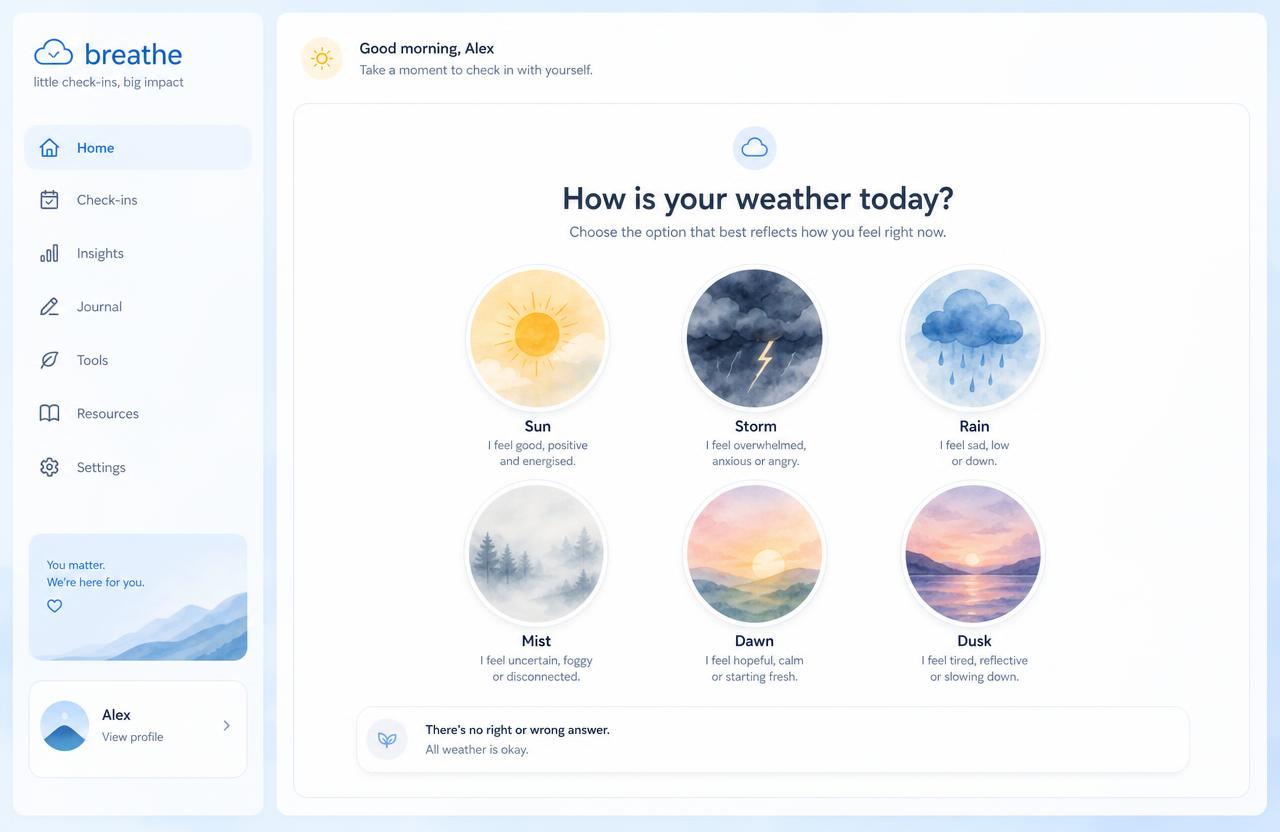
    MySafeTherapy app screen showing the daily Emotional Weather mood check-in with sun, storm, rain, mist, dawn and dusk options

    Emotional Weather check-in

    One tap a day. Ten seconds, and a pattern starts building.

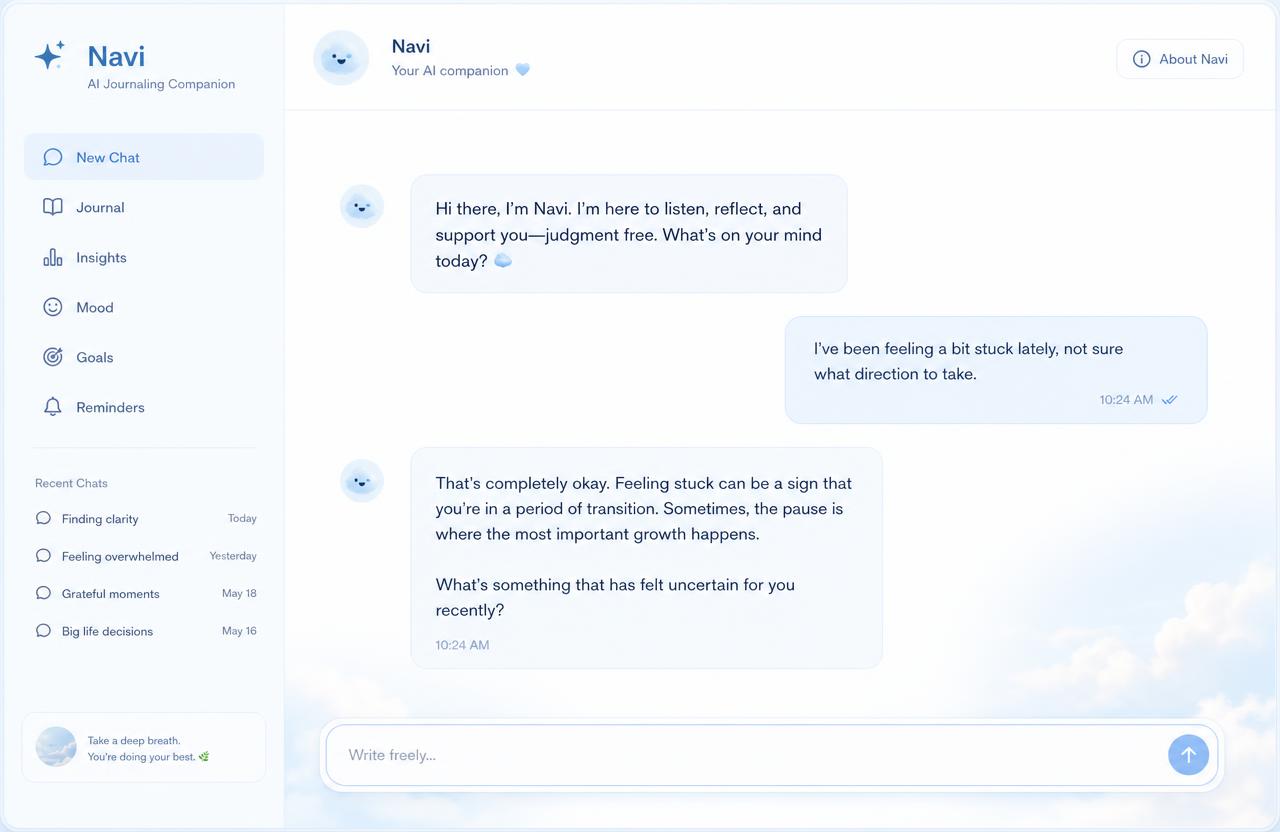
    MySafeTherapy app screen showing AI journaling conversation with Navi, the reflective journaling companion

    Journaling with Navi

    A prompt instead of a blank page, whenever the words won't come.

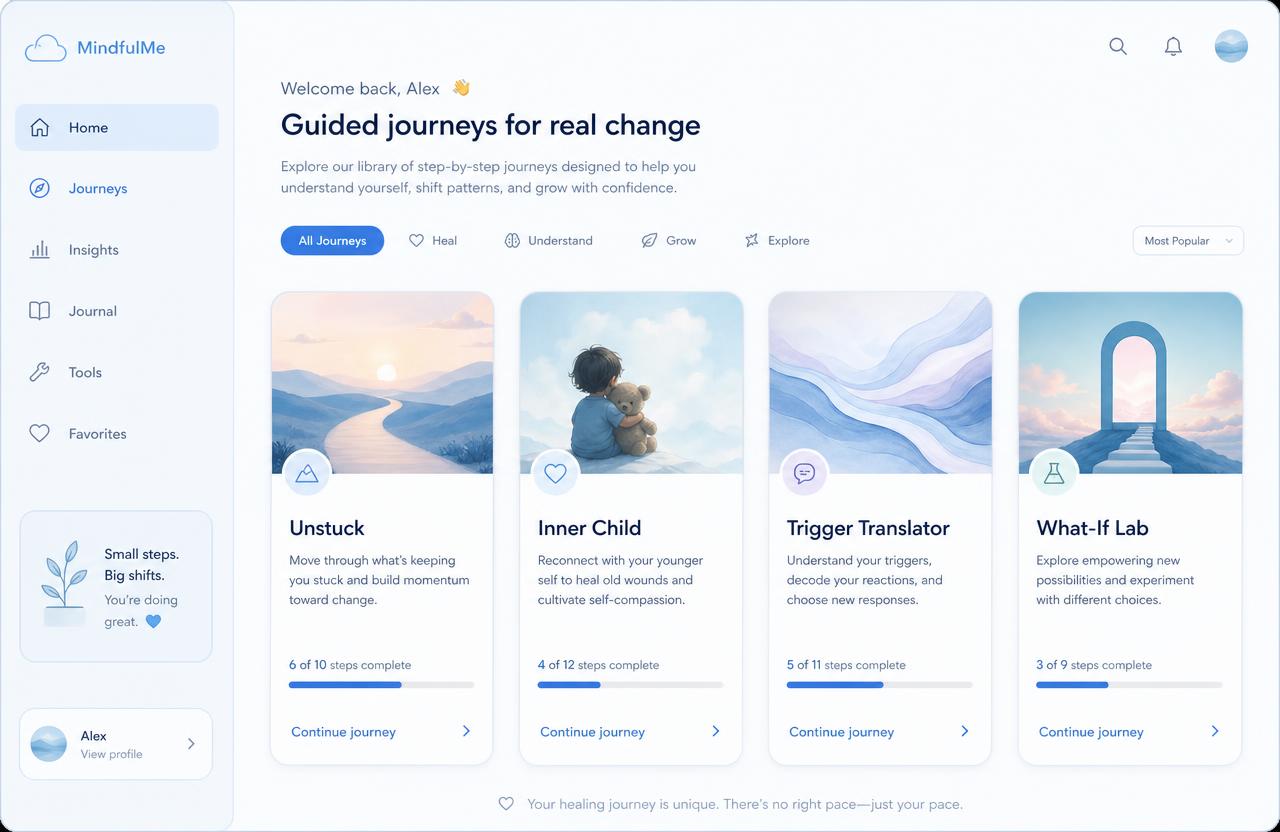
    MySafeTherapy app screen showing guided self-help journeys Unstuck, Inner Child, Trigger Translator and What-If Lab with progress bars

    Guided journeys

    Therapist-designed paths, worked through one short step at a time.

    Why it matters

    Most of the change happens between the sessions

    Fifty minutes a week is roughly half a percent of your waking life. What happens in the other ninety-nine and a half is where therapy either takes or does not.

    Between-session practice predicts outcome

    Across the CBT literature, clients who complete between-session tasks improve more than those who do not, and the effect holds after controlling for how motivated people were at the start. The tasks are not homework for the therapist's benefit — they are the part where a new response gets rehearsed often enough to become available under stress.

    Memory for feeling is unreliable

    Asked on a Tuesday how the previous fortnight went, most people answer with how the last two days went. A daily one-tap check-in replaces that reconstruction with a record, which changes what a session can work on: not 'it's been up and down' but 'the three worst days were all Sundays'.

    Writing reduces rumination

    Expressive writing about a difficulty is associated with lower rumination and improved mood, particularly when it moves from describing events toward making sense of them. The obstacle is almost always the blank page, which is precisely what a prompt removes.

    Understanding is itself treatment

    Psychoeducation reliably lowers distress on its own. Learning that a panic attack is a survival response peaking and falling within minutes changes how the next one is experienced — the fear of the fear is often the larger half of the problem.

    The toolkit

    What's in the toolkit

    Six tools, each doing one job. You do not need all of them — most people use two.

    Emotional Weather check-ins

    What it is. A one-tap daily mood check that asks you to name today as weather — sun, storm, rain, mist, dawn or dusk.

    Why it helps. Naming an emotional state reduces its intensity; it is one of the few self-help actions with a consistent evidence base behind it. Over weeks the check-ins build a pattern you and your therapist can read together, which is far more useful than trying to remember how a fortnight felt.

    How to use it: Once a day, ten seconds. Consistency matters more than detail.

    AI journaling with Navi

    What it is. A gentle AI companion that prompts you, reflects your words back, and helps you put a feeling into language when you cannot find the sentence yourself.

    Why it helps. Expressive writing about difficult experiences is associated with improved mood and reduced rumination. The hard part for most people is starting — a prompt removes the blank page. Navi asks questions; it does not diagnose, advise or assess risk.

    How to use it: After a hard moment, or the evening before a session. Five minutes is enough.

    Guided journeys

    What it is. Therapist-designed self-help paths — Unstuck, Inner Child, Trigger Translator, What-If Lab — worked through one short step at a time.

    Why it helps. Structured between-session tasks are the mechanism by which CBT-family therapies produce change. A journey gives that structure to people who are not currently in therapy, and reinforces it for people who are.

    How to use it: Pick the journey that matches what is loudest this week, not the one that sounds most impressive.

    Booklets library

    What it is. Illustrated, read-only booklets on anxiety, sleep, boundaries, grief and more, written by qualified therapists.

    Why it helps. Psychoeducation — simply understanding what your nervous system is doing — reliably reduces distress on its own. Knowing that a panic attack peaks and falls within minutes changes how you experience the next one.

    How to use it: Read one before bed. Nothing to download, nothing to fill in.

    MySafe awareness videos

    What it is. Short, expert-led videos explaining what is happening in your mind, with one practical tool per video.

    Why it helps. For people who do not read well when distressed, a five-minute video lands where a page of text does not.

    How to use it: Watch one before your therapy session so you arrive with the vocabulary already in place.

    Progress and insights

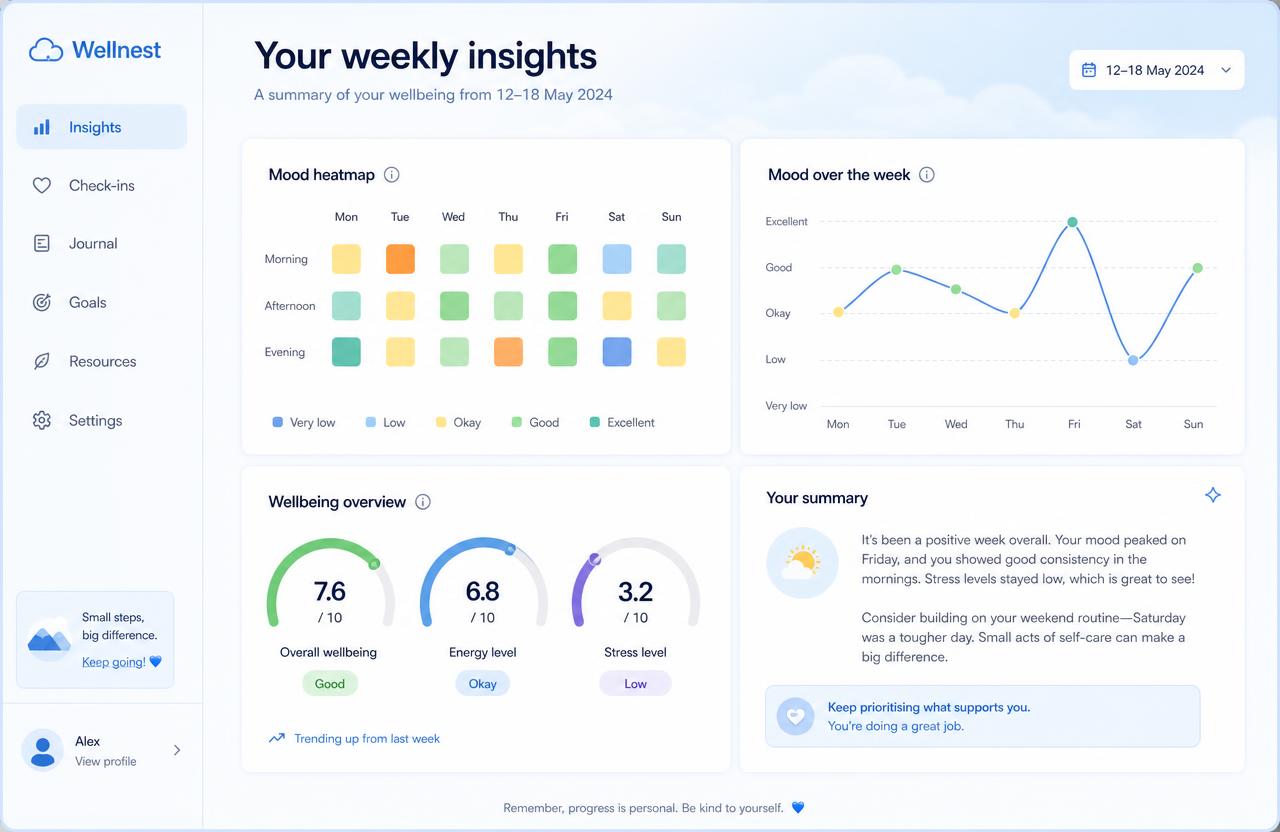
    What it is. A journey ribbon, wellbeing gauges, a mood heatmap and a weekly AI-written summary of what your entries suggest.

    Why it helps. Change in therapy is slow and non-linear, which makes it very easy to conclude nothing is working. Seeing eight weeks laid out is often the first evidence someone accepts that something has shifted.

    How to use it: Review weekly. Bring anything surprising to your next session.

    Your weekly report

    What you get back after a week of using the tools

    Every Sunday the app turns your check-ins and journal entries into a short, readable summary — a mood heatmap, wellbeing gauges and a written note on what shifted.

    MySafeTherapy weekly insights report showing a mood heatmap, mood-over-the-week chart, wellbeing gauges and a written AI summary

    How to use it in your therapy session

    • Open the report on the morning of your session and pick the one line that surprised you — that becomes the opening ten minutes.
    • Bring the heatmap when a week felt uniformly bad; it usually was not, and the exceptions are the useful part.
    • Share the written summary with your therapist if you want to. Nothing is visible to them unless you choose to send it.
    • Compare two reports a month apart when it feels like nothing is changing. This is often the first evidence people accept that it is.

    Boundaries

    What the AI does — and what it will never do

    An honest scope is what makes an AI tool safe to use in mental health. Ours is deliberately narrow.

    It does

    • Ask reflective questions and offer journaling prompts.
    • Summarise patterns in the entries and check-ins you have written.
    • Deliver therapist-written psychoeducation and structured exercises.
    • Signpost crisis services immediately when content suggests risk.
    • Keep everything private unless you actively choose to share it.

    It never does

    • Diagnose a condition or interpret a screening score clinically.
    • Make or influence a treatment decision.
    • Assess suicide or safeguarding risk in place of a human.
    • Present itself as a therapist, or claim a therapeutic relationship.
    • Train third-party AI models on anything you write.

    If you are in crisis, please do not use a self-help tool. Contact Samaritans free on 116 123 (24/7), text SHOUT to 85258, or call 999 if there is immediate danger. See our safety and crisis support page.

    Questions

    Frequently asked questions

    Ready when you are

    Start today. Your first check-in takes ten seconds.

    Create a free account to use the tools, and get your first weekly report in seven days. Self-help subscribers also get £10 off every therapy session.

    MySafeTherapy

    Important: MySafeTherapy is not a crisis or emergency service. If you are in immediate danger or thinking of harming yourself, please contact your local emergency services or a crisis helpline in your country.

    We value your privacy

    We use cookies to enhance your browsing experience and analyze our traffic. By clicking "Accept", you consent to our use of cookies. Learn more about our cookie and privacy policy