Emotional Weather: How Naming Your Feelings Calms Your Nervous System
How we write: drafts are prepared with AI assistance, then edited and checked by Sana Fatima (MBACP, MSc Psychology) before publishing.
Why naming a feeling helps
Have you ever had a day where something felt "off", but you could not say what? Many people know that feeling. You are tense, tired or snappy, and when someone asks what is wrong, the only honest answer is "I don't know".
Psychologists have studied what happens when we put feelings into words. In a well-known brain imaging study, researchers at UCLA found that simply labelling an emotional image with a feeling word reduced activity in the amygdala, the part of the brain that reacts to threat, and increased activity in a region linked to regulating emotion (Lieberman et al., 2007). Later work describes this "affect labelling" as a quiet, almost automatic form of emotion regulation: you are not trying to calm down, yet naming the feeling takes some of the heat out of it (Torre and Lieberman, 2018).
You may have heard the phrase "name it to tame it". It is a simple idea, and it is backed by a growing body of research.
Why it is so hard to find the words
If naming helps, why don't we all do it? There are a few reasons.
- Feelings are often mixed. You can feel relieved and guilty at the same time, or angry and sad at once.
- Many of us were never taught. If feelings were not talked about at home, the vocabulary may simply never have developed.
- Stress narrows thinking. When you are overwhelmed, the part of the brain that finds precise words is the first to go quiet.
- Numbness is a feeling too. Sometimes the honest answer is flat or empty, and that is hard to describe.
Researchers call the ability to tell feelings apart "emotional granularity" or "emotion differentiation". People who can describe their feelings in more detail tend to cope better with stress and are less likely to turn to unhelpful coping such as drinking or bingeing (Kashdan, Barrett and McKnight, 2015). The good news is that this is a skill, and like any skill it grows with practice.
Weather as a language for feelings
Most people can say "it feels foggy" or "there is a storm in me" even when they cannot say "I feel anxious and ashamed". Metaphor gives you a softer way in. It is less exposing than naming an emotion directly, and it often captures the texture of a mood better than a single word.
Weather also carries a helpful message: it changes. A storm is intense, but it passes. Fog lifts. Even long grey spells end. Thinking about your mood as weather can quietly remind you that what you feel right now is not permanent and is not the whole of who you are.
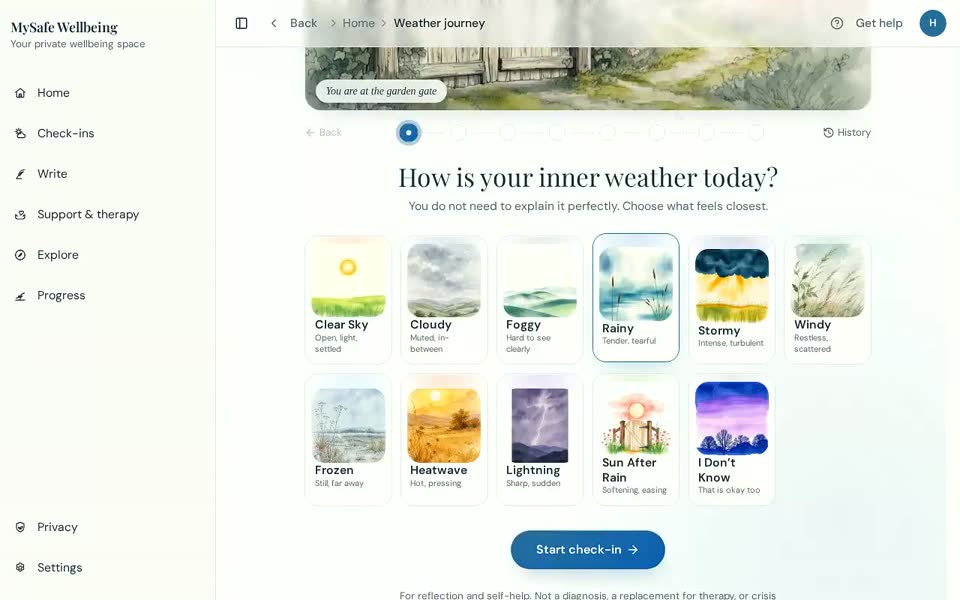
The Inner Weather check-in offers eleven kinds of weather, from Clear Sky and Sunshine to Fog, Drizzle, Storm and Lightning, plus "I don't know", because that is okay too. You do not need to get it exactly right. You just pick the one that feels closest.
How the check-in works
The check-in takes around two to three minutes. Here is what each step does and why it is there.
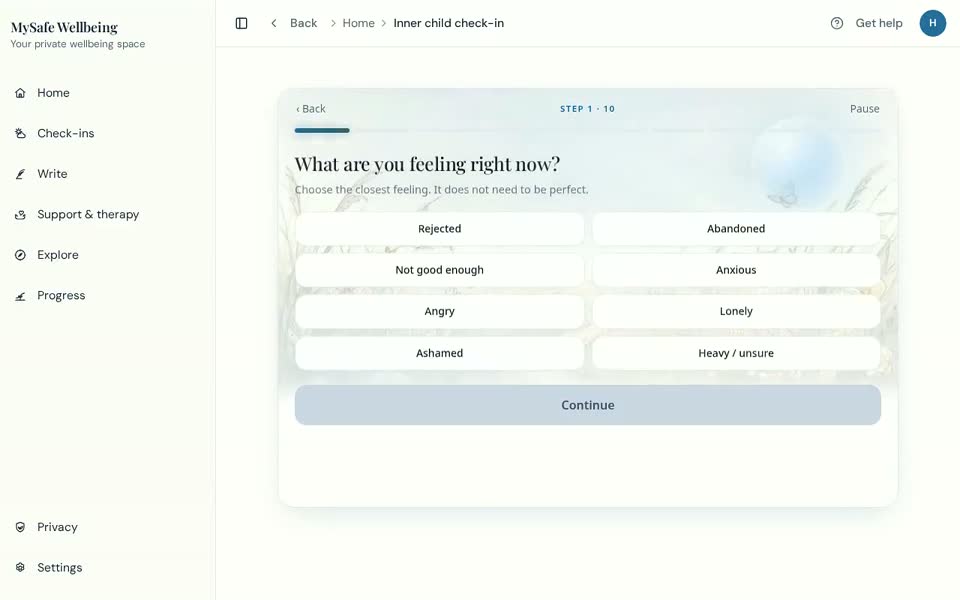
- Choose your weather. Pick the picture that feels closest. This is the labelling step, the part the research above points to.
- Rate how strong it feels. A gentle 1 to 10 slider, with no right answer. Rating intensity helps you notice that feelings come in degrees, and it gives you something to compare against later.
- Notice your body. Short choices such as tight chest, heavy limbs, racing heart or clenched jaw. Emotions show up in the body first for many people, so this helps you spot them earlier next time.
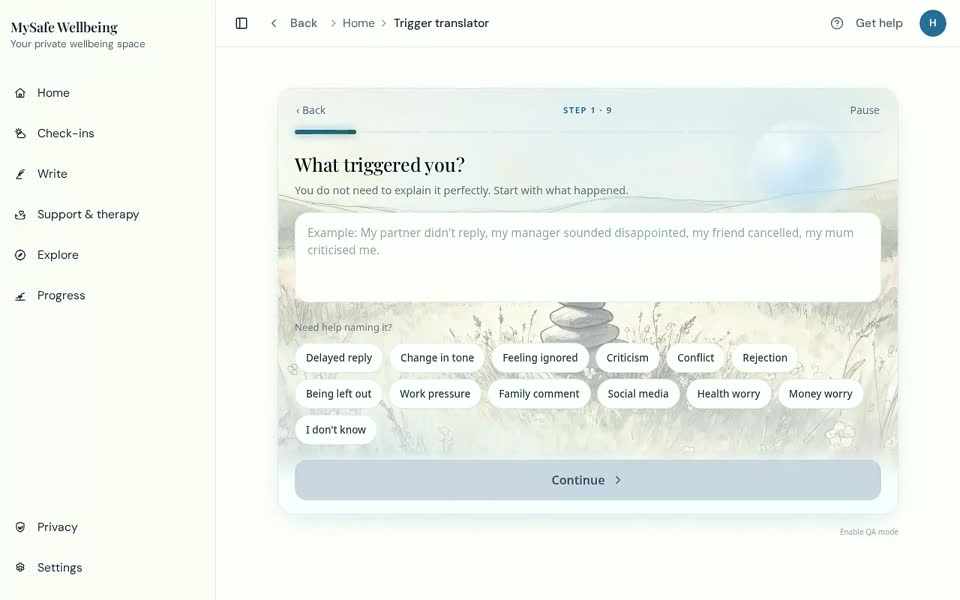
- Notice what set it off. Work, a relationship, money, sleep, health or "nothing obvious". Seeing triggers written down makes patterns easier to spot.
- Name what you need. A boundary, a plan, rest, to cry, to feel heard, to feel safe. Moving from "what I feel" to "what I need" is one of the most useful shifts in emotional self-care.
- Take one gentle next step. For example, a slow breath where the out-breath is longer than the in-breath, a glass of water, a short walk or a message to someone you trust.
Why the next step matters
A check-in that stops at "I feel awful" can leave you stuck. That is why every Inner Weather check-in ends with one small, doable action.
Slow breathing is a good example. Studies of slow, paced breathing link it with changes in heart rate variability and with feeling calmer and more alert (Zaccaro et al., 2018). A 2023 study at Stanford found that just five minutes a day of breathing with a long, slow exhale improved mood and reduced anxiety more than mindfulness meditation over a month (Balban et al., 2023).
The aim is not to make the feeling vanish. It is to help your body feel a little safer so you can choose what to do next, rather than react on autopilot.
How it helps over time
One check-in can help in the moment. The bigger benefit comes from doing it regularly.
- You spot patterns. You might notice that Sunday evenings are often foggy, or that stormy days follow poor sleep.
- You catch things earlier. When you know your early warning signs, such as a tight jaw or irritability, you can act before things build up.
- You see progress. On low days it is easy to feel that nothing ever changes. Looking back at weeks of check-ins often tells a kinder, more accurate story.
- Therapy becomes more focused. If you see a therapist, your notes give you real examples to bring to sessions, instead of trying to remember how the week felt.
The NHS mood self-assessment and many NHS Talking Therapies services encourage keeping track of mood for exactly these reasons (NHS Every Mind Matters). Read more about mood tracking and check-ins.
A short example
Imagine Priya, 29, who has felt flat all week. She opens the check-in and picks Fog. She rates it 6 out of 10, notices heavy shoulders and a tired head, and ticks "work" and "sleep" as possible triggers. For what she needs, she chooses "rest". Her next step is to put her phone down ten minutes earlier tonight.
Nothing dramatic happened. But Priya now knows a little more about her week, and she has one kind thing to do for herself. Over a month, she notices foggy days cluster after late nights, which becomes something she brings to her therapist.
Tips for getting the most from it
- Keep it short. Two minutes a day beats one long session a month.
- Pick a regular moment, such as after lunch or before bed. Linking a new habit to an existing routine makes it more likely to stick (Lally et al., 2010).
- Be honest, not perfect. "I don't know" is a valid answer.
- Be kind about what you find. The goal is understanding, not judging yourself.
When to get more support
If your weather has been stormy or grey for more than two weeks, if feelings are getting in the way of work, sleep or relationships, or if you are having thoughts of harming yourself, please reach out for support. Our anxiety therapy and depression therapy pages explain how talking to a therapist can help, and you can take our free Do I need therapy? check.
What each kind of weather can mean
There is no fixed dictionary for emotional weather, and your meaning matters more than ours. Still, many people find these loose descriptions helpful as a starting point.
- Clear Sky: settled, calm, able to think clearly. A good moment to notice what helps you feel this way.
- Sunshine: warmth, energy, connection or joy. Worth savouring, even briefly.
- Partly Cloudy: mostly okay with a background niggle. Something is on your mind, but it is manageable.
- Fog: flat, foggy-headed, unmotivated or disconnected. Often linked with tiredness, low mood or feeling numb.
- Drizzle: a low, steady sadness that does not quite spill over.
- Heavy Rain: grief, tearfulness or deep sadness.
- Wind: restless, scattered, unable to settle. Common with stress and overthinking.
- Storm: anger, frustration or many strong feelings at once.
- Lightning: a sudden jolt of panic, shock or fear.
- Snow: frozen, shut down, or wanting to withdraw from the world.
- I don't know: mixed, unclear or hard to read. A perfectly valid check-in.
Over time you may build your own personal meanings. For one person, Wind might mean excitement; for another, dread. The point is to give yourself a consistent language so you can compare days and notice change.
Common questions
Is emotional weather just a gimmick?
No. The weather pictures are a doorway into a well-researched process: noticing, labelling and responding to emotions. Metaphor is widely used in therapy because it helps people talk about experiences that are hard to put into plain words. If you prefer, you can still describe your feelings directly in the notes.
How often should I check in?
Once a day is a good rhythm for most people, but there is no rule. Some people check in only on harder days. Others do a quick morning and evening check-in to see how the day shifted. Choose what feels sustainable rather than what feels ideal.
What if I always pick the same weather?
That tells you something useful. If you have picked Fog or Drizzle most days for a couple of weeks, it may be a sign that your mood has been low for a while. That is a good moment to talk to someone you trust, your GP or a therapist.
Can I use it if I am already in therapy?
Yes. Many people find it useful to bring a week of check-ins to a session. It gives you and your therapist a clearer picture than memory alone, and it can help you spot links between your mood, your body and what is happening in your life.
Is my check-in private?
Yes. Your check-ins are saved privately to your account and are not shared unless you choose to share them.
References
- Lieberman, M. D. et al. (2007). Putting feelings into words: affect labeling disrupts amygdala activity. Psychological Science.
- Torre, J. B. and Lieberman, M. D. (2018). Putting feelings into words: affect labeling as implicit emotion regulation. Emotion Review.
- Kashdan, T. B., Barrett, L. F. and McKnight, P. E. (2015). Unpacking emotion differentiation. Current Directions in Psychological Science.
- Zaccaro, A. et al. (2018). How breath-control can change your life. Frontiers in Human Neuroscience.
- Balban, M. Y. et al. (2023). Brief structured respiration practices enhance mood and reduce physiological arousal. Cell Reports Medicine.
- Lally, P. et al. (2010). How are habits formed? European Journal of Social Psychology.
- NHS Every Mind Matters.
A note on safety
These tools are for reflection and self-help. They are not a diagnosis, a replacement for therapy or crisis support. If you are in immediate danger, call 999. You can call Samaritans any time on 116 123, or text SHOUT to 85258. In the UK you can also call NHS 111 and choose the mental health option.