What Is Inner Child Work? A Gentle Guide to Healing Old Hurts
How we write: drafts are prepared with AI assistance, then edited and checked by Sana Fatima (MBACP, MSc Psychology) before publishing.
What "inner child" means
Inner child work is a way of noticing that some of our strongest reactions carry feelings from when we were younger. Feeling rejected by a friend today can echo times we felt unseen as a child. Being criticised at work can stir the same shame you felt when a parent or teacher was harsh.
"Inner child" is not a diagnosis or a separate personality. It is a helpful way of describing the parts of us that still hold early experiences, both the hurts and the playfulness, curiosity and warmth. Many therapists use it because it makes something complex feel more approachable.
Where the idea comes from
Several established therapies work with these early patterns, even if they use different language.
- Schema therapy, developed by Jeffrey Young, describes "schemas": deep beliefs about ourselves and others that form in childhood when emotional needs such as safety, acceptance and connection are not fully met. It talks about "child modes", the states we slip into when old schemas are triggered (International Society of Schema Therapy).
- Internal Family Systems (IFS) sees the mind as made up of parts, including young, wounded parts that protective parts try to keep hidden (IFS Institute).
- Transactional analysis describes "Parent, Adult and Child" ego states.
- Compassion-focused therapy, developed by Paul Gilbert, helps people build a kinder inner voice, especially those with high levels of shame and self-criticism (Compassionate Mind Foundation).
There is also broad research showing that difficult early experiences can affect health and wellbeing in adulthood (CDC, Adverse Childhood Experiences). That does not mean we are stuck. It means that understanding where our reactions come from can help us respond to them differently.
The belief behind the pain
Often the pain comes from the meaning, not only the event. When a friend cancels plans, the hurt might be less about the evening and more about an old belief it touches: "I'm not important to people".
Common beliefs include:
- "I don't matter."
- "I'm too much."
- "I'm not enough."
- "People always leave."
- "I'm not lovable."
- "It's not safe to need things."
- "I have to be perfect to be accepted."
These beliefs usually formed for good reasons. A child who learned to stay quiet in a chaotic home was protecting themselves. The belief made sense then. The trouble is that it can carry on long after it is needed. Naming the belief is the first step to softening it.
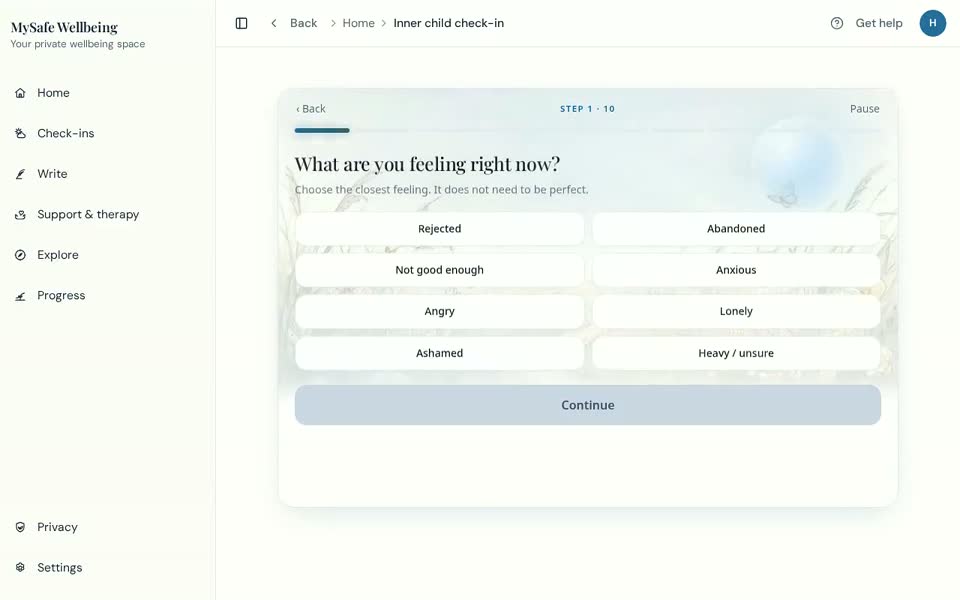
How the Inner Child check-in works
The check-in takes around five minutes and moves gently, one step at a time.
- Choose the closest feeling, such as rejected, abandoned, invisible, ashamed or not good enough.
- Describe what happened, briefly, in today's words.
- Notice what your mind made it mean about you. This is where old beliefs often appear.
- Notice where you feel it in your body: heavy, hot, frozen, empty, tight.
- Ask how old the feeling seems. Sometimes a reaction feels much younger than your age, and noticing that is helpful in itself.
- Respond to your younger self with what they needed to hear, such as "You matter", "It wasn't your fault" or "Your feelings make sense".
- Take one caring action for yourself today, such as rest, a warm drink, a walk or reaching out to someone safe.
Why self-compassion helps
Responding to yourself with kindness can feel awkward at first, especially if you are used to a harsh inner critic. But it is one of the most researched areas in modern psychology.
Psychologist Kristin Neff describes self-compassion as having three parts: being kind to yourself, recognising that struggle is part of being human, and noticing painful feelings without being swept away (Neff, Self-compassion). A meta-analysis of 20 studies found a strong link between higher self-compassion and lower anxiety, depression and stress (MacBeth and Gumley, 2012).
Self-compassion is not self-pity or letting yourself off the hook. People who are kinder to themselves are often more motivated to change, because mistakes feel less threatening. Practising it in a structured way makes it easier to reach for when things feel hard.
A short example
Leah, 31, did not get invited to a colleague's birthday drinks. She feels a sharp sting, out of proportion to the event. In the check-in she chooses "left out", and notices the belief "people don't really want me around". The feeling sits as a heavy knot in her stomach. When asked how old it feels, she realises it feels about nine, the age she often sat alone at school.
She writes to that younger self: "That was lonely. You were never too much. You deserved friends." Her caring action is to text a close friend and arrange a coffee. The sting is still there, but it has softened, and she has a clearer sense of why it hit so hard.
Doing this safely
Inner child work can bring up strong feelings. A few gentle guidelines help:
- Go slowly. You do not need to revisit painful memories in detail. The check-in focuses on the present moment.
- Stop if it feels too much. Ground yourself by noticing five things you can see, or by slowing your breath.
- It is not about blame. Understanding where a belief came from does not mean blaming anyone; it means understanding yourself.
- Get support for trauma. If you experienced abuse or neglect, working with a trained therapist is the safest way to explore these memories. Our trauma therapy page explains more.
How it helps over time
Like any practice, the benefit grows with repetition. Over weeks, you may notice the same two or three beliefs coming up. That awareness is powerful. You start to catch "there's that 'I'm too much' feeling again" earlier, and respond with the voice you have been practising rather than the old critic.
When to get more support
If old patterns keep shaping your relationships, self-esteem or mood, therapy can help you understand and change them at a deeper level. For deeper work, see our self-worth and self-esteem and relationship counselling pages, or book a free 15-minute consultation through start therapy.
Signs an old wound may be involved
It is not always obvious when a reaction is coming from an older place. A few signs suggest an inner child part may be involved:
- The reaction feels much bigger than the situation, and you struggle to explain why.
- You feel younger than your age, for example small, helpless or desperate for approval.
- The same feeling keeps returning in different relationships, workplaces or friendships.
- You use absolute words, such as "always" and "never". "People always leave." "I never get it right."
- Your inner voice sounds like someone from your past, such as a critical parent or teacher.
None of these signs mean something is wrong with you. They are simply clues that a current moment may be touching something older, and that it deserves gentleness.
Ways to reparent yourself day to day
"Reparenting" is a term many therapists use for learning to give yourself the care you may not have received growing up. Alongside the check-in, small everyday practices can help:
- Speak to yourself as you would to a child you love, especially after a mistake.
- Meet basic needs kindly: regular meals, enough sleep, rest when you are tired.
- Allow play and curiosity, such as drawing, music, dancing or time outdoors, without needing it to be productive.
- Set small boundaries that protect your energy, and notice how it feels to keep them.
- Celebrate small wins, even ones that seem tiny to others.
Inner child work and the inner critic
Many people discover that the harshest voice in their head is not really theirs. It may echo a parent, teacher, sibling or culture that expected perfection or discouraged feelings. In schema therapy this is sometimes called the "demanding" or "punitive" critic.
Inner child work invites a third voice into the conversation: a caring, grown-up part of you that can stand between the critic and your younger self. When the critic says "you're pathetic for being upset", the caring voice might say "you're upset because this matters, and that's okay".
At first this voice may feel quiet or unfamiliar. With practice, it often becomes stronger. Compassion-focused therapy describes this as building a "compassionate self", and it has been shown to help people with high levels of shame and self-criticism.
A note on language
Some people love the phrase "inner child", while others find it awkward. If it does not sit well with you, use whatever words feel right: "the younger part of me", "the part that gets scared", or simply "old feelings". The words matter less than the attitude of curiosity and kindness behind them.
Key takeaways
- Strong present-day reactions can carry feelings from earlier in life.
- Naming the old belief underneath is the first step to softening it.
- Self-compassion is strongly linked with lower anxiety and depression.
- Go gently, and seek a therapist's support for trauma.
- Small, regular acts of care add up over time.
Common questions
Do I need to remember my childhood clearly?
No. Many people have patchy memories, and that is normal. The check-in focuses on what you feel now and the beliefs that show up in the present. You do not need to recall specific events for it to help.
Is this the same as blaming my parents?
No. Most parents and carers do their best with what they have. Understanding where a belief came from is about compassion for your younger self, not blame. You can hold both: love for the people who raised you and recognition of what you needed and did not get.
What if responding kindly to myself feels fake?
That is very common, especially if you have a strong inner critic. Self-compassion is a skill that grows with practice. Start small, with one kind sentence, and notice even slight shifts. It often feels more natural over time.
Can inner child work help with relationships?
Often, yes. Many relationship difficulties, such as fear of abandonment, people-pleasing or difficulty trusting, connect to early beliefs. Understanding them can help you respond differently with partners, friends and family.
References
- International Society of Schema Therapy.
- IFS Institute. The Internal Family Systems model.
- The Compassionate Mind Foundation.
- Centers for Disease Control and Prevention. About adverse childhood experiences.
- Neff, K. What is self-compassion?
- MacBeth, A. and Gumley, A. (2012). Exploring compassion: a meta-analysis of the association between self-compassion and psychopathology. Clinical Psychology Review.
A note on safety
These tools are for reflection and self-help. They are not a diagnosis, a replacement for therapy or crisis support. If you are in immediate danger, call 999. You can call Samaritans any time on 116 123, or text SHOUT to 85258. In the UK you can also call NHS 111 and choose the mental health option.