Therapeutic Journaling in 5 Minutes a Day: Beating the Blank Page
How we write: drafts are prepared with AI assistance, then edited and checked by Sana Fatima (MBACP, MSc Psychology) before publishing.
Why journaling helps
Writing about how you feel can seem too simple to make a difference. Yet it is one of the most studied self-help practices in psychology.
In the 1980s, psychologist James Pennebaker asked students to write about their deepest thoughts and feelings for 15 to 20 minutes on a few days in a row. Compared with people who wrote about neutral topics, they later visited the doctor less often and reported better wellbeing (Pennebaker, 1997). This became known as "expressive writing", and it has since been tested in hundreds of studies. A large review found small but meaningful benefits for both mental and physical health (Frattaroli, 2006).
More recent research has looked at lighter, shorter journaling. A study of adults with anxiety found that just 15 minutes of positive-focused journaling three times a week for 12 weeks reduced mental distress and improved wellbeing (Smyth et al., 2018).
How writing helps the mind
There are a few reasons writing seems to help.
- It slows thoughts down. Thoughts can race and loop. Writing forces them into a line, one at a time.
- It moves things out of your head. Once a worry is on the page, it often feels more manageable and less overwhelming.
- It helps you make sense of events. Pennebaker found that people who benefited most tended to use more words like "because" and "realise" over time, a sign they were building a story that made sense.
- It names feelings. Putting emotions into words can calm the brain's threat response, as research on affect labelling has shown (Lieberman et al., 2007).
- It builds self-awareness. Over weeks, entries reveal patterns you may not notice day to day.
Why most people stop
Most people who try journaling give up quickly. The most common reason is the blank page. "What do I even write?" "This feels silly." "I don't have time." Others start strong, then miss a few days and feel they have failed.
There is also a quieter worry: privacy. Many people hold back because they fear someone might read it. Feeling safe is essential for honest writing.
Prompts take a lot of that pressure away. Instead of facing an empty page, you answer one small, specific question.
How it works in the MySafeTherapy app
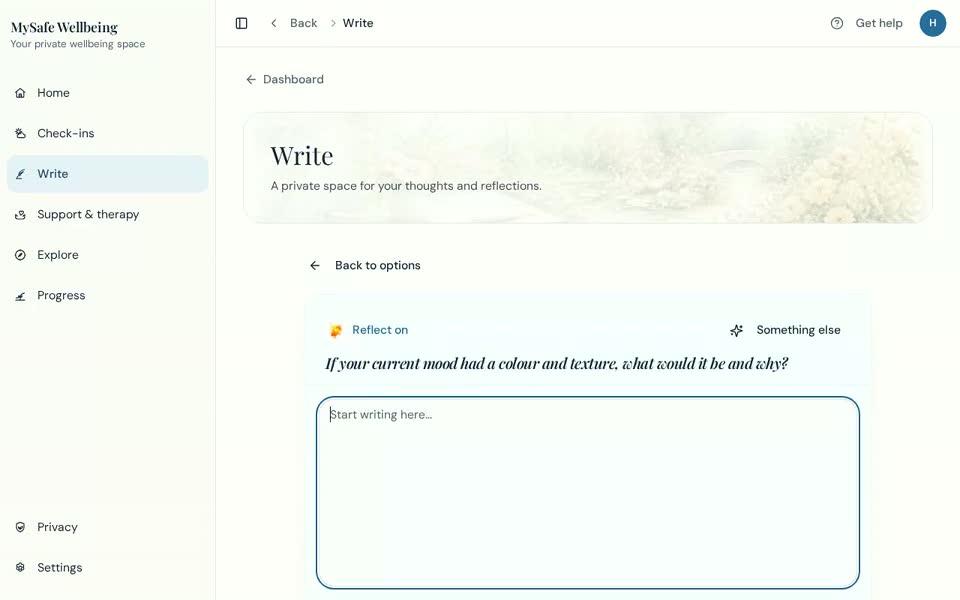
Our journaling space is designed to make five minutes of writing feel easy.
- A gentle prompt to start, like "If your current mood had a colour and texture, what would it be?" or "What is one thing you are carrying today that you would like to put down?" Tap "Something else" for a new one.
- Write freely in a private space. There are no word counts, no grammar checks and no right answers.
- Talk it through with Navi, an AI journaling companion who reflects back what you shared and asks a kind follow-up question, much like a thoughtful friend might.
- Look back at past entries to see how things have shifted over time.
About Navi
Navi is there to help you keep writing and reflect a little deeper. For example, if you write "I'm exhausted and I snapped at my sister", Navi might reflect, "It sounds like you're running on empty, and that moment with your sister is weighing on you. What do you think was underneath the snap?"
Navi is a reflection tool. It does not diagnose, it does not make clinical decisions and it is not a therapist. It will not tell you what is "wrong" with you. If you write something that suggests you may be at risk, it will point you towards crisis support. Learn more on our AI journaling page.
The British Psychological Society and other bodies have urged caution about AI in mental health, especially around safety and privacy (British Psychological Society). That is why we keep AI in a supportive, reflective role and keep human therapists at the centre of care.
Prompts to get you started
If you would like to try journaling right now, here are some prompts you can use on paper or in the app.
- What is taking up the most space in my mind today?
- What am I feeling, and where do I feel it in my body?
- What do I need right now that I am not getting?
- What is one small thing that went okay today?
- If a close friend were in my situation, what would I say to them?
- What am I avoiding, and why?
- What would make tomorrow 1% easier?
Make it a habit
Five minutes is enough. In fact, short and regular tends to work better than long and rare. A few tips:
- Anchor it to something you already do, such as your morning coffee or getting into bed. Research on habit formation shows that linking a new behaviour to a consistent cue helps it become automatic, typically over weeks rather than days (Lally et al., 2010).
- Lower the bar. On hard days, one sentence counts.
- Do not reread straight away if it feels raw. Come back in a week with fresh eyes.
- Let go of "doing it right". Spelling, grammar and neatness do not matter.
- Balance hard and good. Writing only about pain can sometimes leave you feeling worse. Try ending each entry with one thing you are grateful for or one small next step.
Journaling and therapy
Journaling and therapy work well together. Many therapists encourage writing between sessions because it keeps the work going in the 167 hours outside the therapy room. Entries can help you remember what came up during the week and bring real examples to your session. If you choose, you can share themes with your therapist.
Journaling is not a substitute for therapy if you are struggling with persistent low mood, anxiety or trauma. Expressive writing can sometimes bring up difficult feelings in the short term, so if writing about something painful leaves you feeling much worse, pause and reach out for support.
When to get more support
If your journal keeps returning to the same heavy themes, or you notice your mood has been low for weeks, it may be a good time to talk to someone. Our depression therapy and stress management pages explain how a therapist can help, or you can take our free Do I need therapy? check.
Different ways to journal
There is no single right way to keep a journal. If one style does not suit you, try another.
- Free writing: set a timer for five minutes and write whatever comes, without stopping or editing.
- Prompted journaling: answer one specific question. This is what the app offers by default.
- Expressive writing: write about a difficult experience, focusing on your deepest thoughts and feelings, for 15 to 20 minutes on a few days in a row. This is the method Pennebaker studied.
- Gratitude journaling: list three things that went well and why. Simple, and linked with improved mood in several studies.
- Bullet journaling: short notes, lists and symbols rather than full sentences. Good if you find long writing tiring.
- Letter writing: write a letter you will never send, to someone you are angry with, someone you miss or your younger self.
You can mix and match. Many people use quick prompts on busy days and longer writing when something big is on their mind.
What to do with hard entries
Sometimes a journal entry brings up more than you expected. That is a normal part of writing honestly. A few gentle steps can help afterwards:
- Pause and breathe slowly before moving on with your day.
- End with something grounding, such as one thing you can see, one thing you are grateful for or one small plan.
- Close the app or notebook and do something soothing, such as a walk, a shower or a cup of tea.
- Reach out to someone you trust if the feelings stay strong.
If a particular topic consistently leaves you distressed, it may be best explored with a therapist, who can help you process it safely.
Journaling for specific situations
Prompts can be tailored to what you are going through. When anxious, try "What exactly am I afraid will happen, and what would I do if it did?" When low, "What is one thing, however small, that I can do for myself today?" After an argument, "What did I need in that moment that I didn't get?" When grieving, "What do I want to remember about them today?" Matching the prompt to the moment often makes writing feel more relevant and less like a chore.
Key takeaways
- Expressive writing is one of the most researched self-help practices in psychology.
- Writing slows racing thoughts, names feelings and helps you make sense of events.
- Prompts remove the pressure of the blank page.
- Five minutes, a few times a week, is enough to start.
- Navi supports reflection but is not a therapist and does not make clinical decisions.
- Journaling works well alongside therapy, not instead of it.
A final thought
You do not need to be a writer to benefit from journaling. You only need a few honest minutes and a little curiosity about yourself. Start with one prompt today, and see what you notice.
Common questions
Do I have to write every day?
No. A few times a week is enough to see benefits. Consistency matters more than frequency, so pick a rhythm you can keep.
Does Navi read everything I write?
Navi only responds when you choose to talk an entry through with it. Your journal is private to your account, and entries are not shared with anyone unless you decide to share them.
What if I don't like writing?
Short answers count. Even one line a day can help you notice patterns. You might also find the guided check-ins, which use taps and sliders, easier on some days.
Can journaling replace therapy?
Journaling is a helpful self-care practice, but it is not a replacement for therapy if you are struggling. It works best alongside other support.
References
- Pennebaker, J. W. (1997). Writing about emotional experiences as a therapeutic process. Psychological Science.
- Frattaroli, J. (2006). Experimental disclosure and its moderators: a meta-analysis. Psychological Bulletin.
- Smyth, J. M. et al. (2018). Online positive affect journaling in the improvement of mental distress and well-being. JMIR Mental Health.
- Lieberman, M. D. et al. (2007). Putting feelings into words. Psychological Science.
- Lally, P. et al. (2010). How are habits formed? European Journal of Social Psychology.
- British Psychological Society.
A note on safety
These tools are for reflection and self-help. They are not a diagnosis, a replacement for therapy or crisis support. If you are in immediate danger, call 999. You can call Samaritans any time on 116 123, or text SHOUT to 85258. In the UK you can also call NHS 111 and choose the mental health option.