The 167-Hour Gap: Why Support Should Continue Between Therapy Sessions
How we write: drafts are prepared with AI assistance, then edited and checked by Sana Fatima (MBACP, MSc Psychology) before publishing.
The 167-hour gap
There are 168 hours in a week. A typical therapy session takes one of them. That leaves 167 hours where life happens: the hard conversation with your partner, the Sunday night dread, the 3am worry, the moment at work when you suddenly feel overwhelmed.
Weekly therapy is powerful. But most of the change it brings happens in between sessions, when you try out new ways of thinking and responding in real life. Hard moments rarely wait for your next appointment. Having support in those moments helps insights from therapy stick.
What research says about between-session practice
Therapists have long known that what happens between sessions matters. In CBT, for example, clients are often asked to practise skills or keep records during the week. A meta-analysis found that people who completed more of these between-session tasks, and did them well, tended to improve more (Kazantzis et al., 2016).
There are a few reasons this makes sense:
- Skills need practice. Like learning a language or an instrument, new habits of mind grow through repetition, not one weekly lesson.
- Memory fades. Without reminders, it is easy to forget what you discussed in a session by the next day.
- Real life is where change shows. Noticing a thought in the moment is very different from discussing it a week later.
- Momentum builds hope. Small wins during the week can make you feel that progress is possible.
Why gaps can be hard
The time between sessions can also be the hardest part of therapy. Sessions sometimes stir things up. You might leave feeling raw, then have nowhere to put those feelings for a week. Some people find themselves saving everything up for the session, then forgetting it when they arrive. Others feel alone in the gaps, especially in the early weeks.
UK charities such as Mind note that therapy is most helpful when people feel supported and able to engage with it fully (Mind, Talking therapy and counselling). Thoughtful tools between sessions can make the gaps feel less empty.
What is inside the MySafeTherapy app
The app is designed to fill those 167 hours with gentle, practical support. Here is a quick tour.
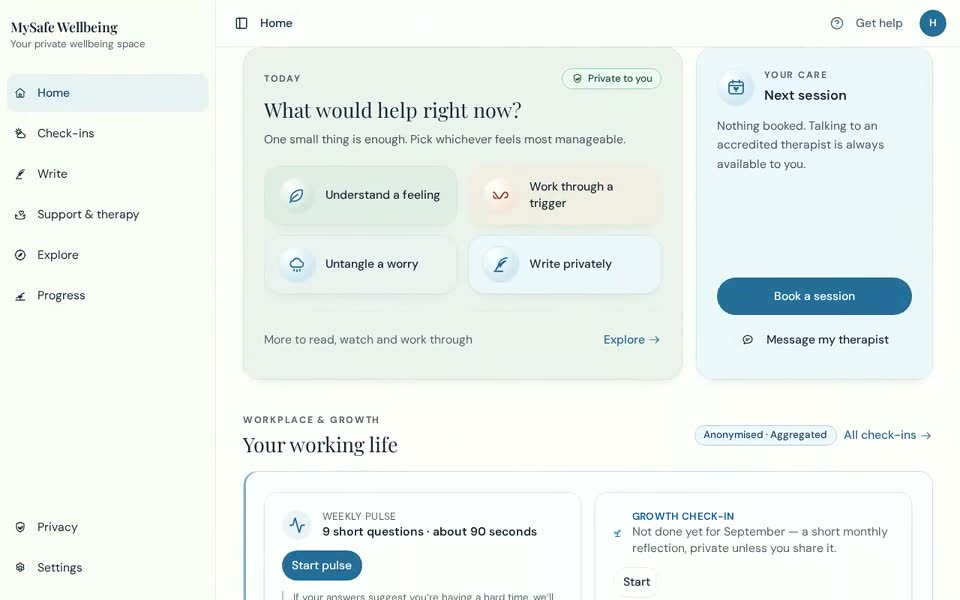
"What would help right now?"
When something hits, you do not always know which tool you need. The home screen asks one simple question and offers clear choices: understand a feeling, work through a trigger, untangle a worry, or write privately. One tap takes you to the right place.
Guided check-ins
Short, structured exercises based on established therapy approaches:
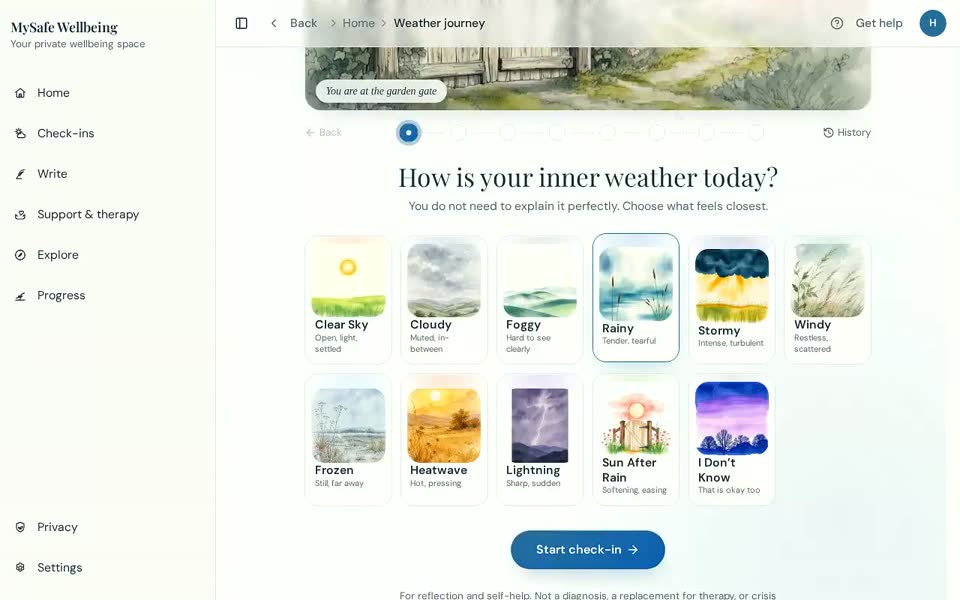
- Inner Weather helps you name your mood using weather, notice your body and choose one gentle next step.
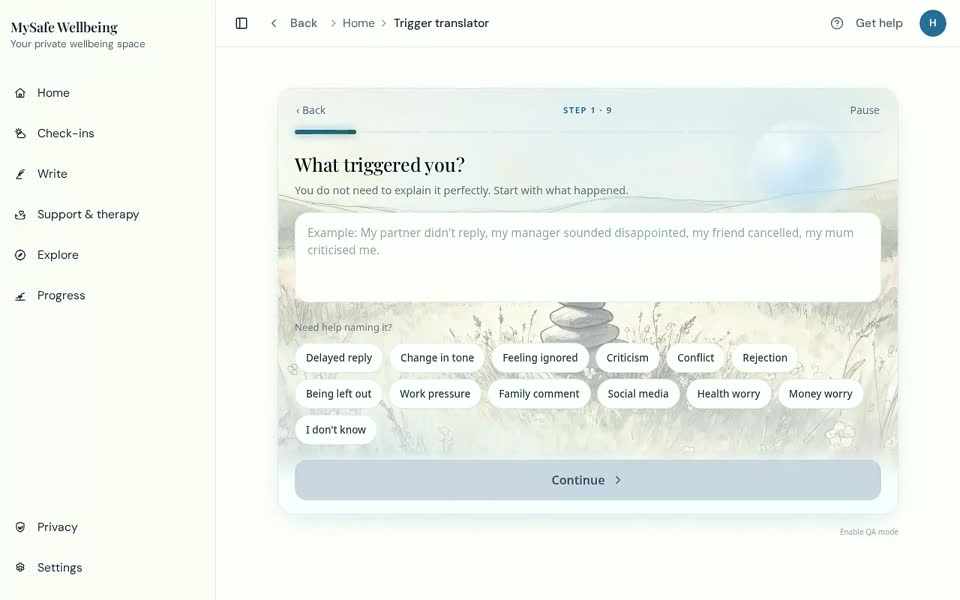
- Trigger Translator uses CBT ideas to separate what happened from the story your mind added.
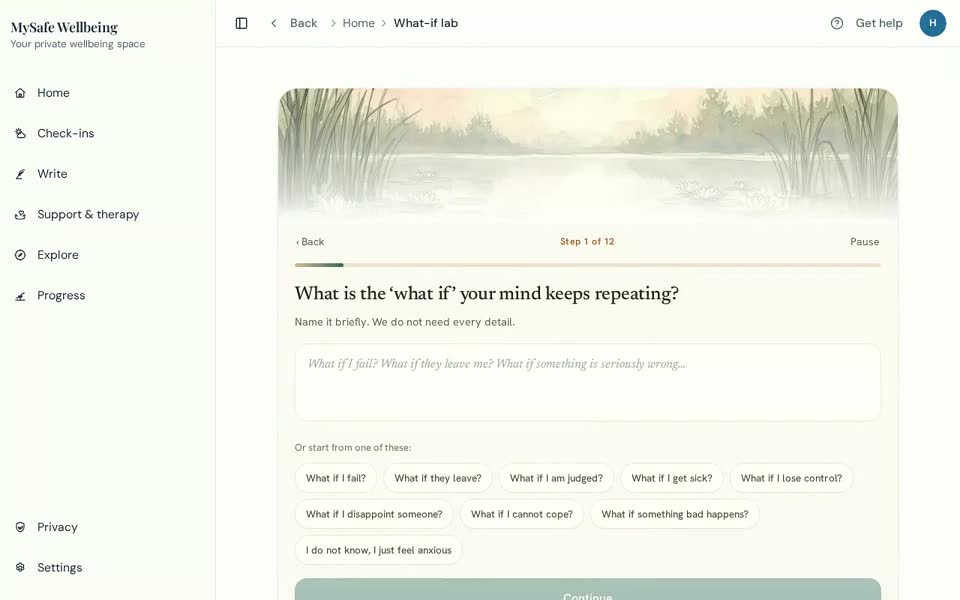
- What-If Lab walks you through anxious "what if" thoughts, from the worst case to a grounded next step.
- Inner Child check-in helps you notice old beliefs and respond to them with self-compassion.
Journaling with Navi
A private space to write, with gentle prompts and Navi, an AI companion that reflects back what you shared and asks a kind follow-up question. Navi is a reflection tool, not a therapist, and it does not make clinical decisions. Read more in our guide to guided journaling.
Exercises and worksheets
Practical activities you can do in one sitting and return to, covering areas such as anxiety, sleep, self-esteem, boundaries and stress. These draw on approaches like CBT, acceptance and commitment therapy and compassion-focused therapy.
Your garden
Every time you check in, journal or complete an exercise, your private garden grows a little. It is a gentle visual reminder that showing up for yourself adds up, even on days that feel like nothing changed. Research on habit formation suggests that consistency over weeks, not perfection, is what builds lasting habits (Lally et al., 2010).
Your care
If you work with one of our therapists, you can book sessions and send private messages through the app, keeping everything in one place.
How therapists can use it with you
If you see a MySafeTherapy therapist, the tools can become part of your therapy, if you want them to be. Your therapist might suggest a particular check-in to try during the week, or you might bring a pattern you noticed in your journal to your next session. Many people find this makes sessions more focused, because you arrive with real examples instead of trying to remember how the week felt.
You stay in control of what you share. Some people prefer to keep their journal entirely private, and that is completely fine.
Private by design
Your reflections are private to you. Nothing is shared unless you choose to. We follow UK data protection law (UK GDPR) and our therapists are members of professional bodies such as the BACP, UKCP and NCPS, which set standards for confidentiality and ethical practice (BACP Ethical Framework).
What these tools are not
The app is not a replacement for therapy, a diagnosis, or emergency support. The AI features do not make clinical decisions. Tools are there to help you reflect, practise and notice, alongside human care where you want it, not instead of it.
The NHS recommends speaking to a professional if low mood, anxiety or stress last more than a couple of weeks or start affecting daily life (NHS, Mental health services).
A week in the life
Here is how the tools might fit into an ordinary week for someone in therapy.
- Monday: a two-minute Inner Weather check-in after work. Foggy, 5 out of 10.
- Wednesday: a tense message from a friend. A Trigger Translator entry helps separate facts from the story.
- Thursday night: worry about a health appointment. Ten minutes in the What-If Lab.
- Saturday: five minutes of journaling with Navi about the week.
- Next session: you bring the Wednesday pattern to your therapist, and it becomes the focus.
None of this takes long. Together, it keeps the work going.
Ready for a therapist too?
If you would like a person alongside the tools, find a therapist or start therapy with a free 15-minute consultation call. You can also explore our mental health support between therapy sessions page.
How to get the most from your sessions
The time between sessions is also a chance to prepare for the next one. A few small habits can make each hour of therapy go further.
- Jot down moments as they happen. A quick note in your journal or a check-in is easier than trying to remember on the day.
- Notice what stayed with you after your last session. A sentence, an idea or a feeling is worth bringing back.
- Pick one focus before you arrive. It is fine if the session goes somewhere else, but having a starting point helps.
- Try one small experiment during the week, such as saying no once or noticing a thinking trap, and share how it went.
- Be honest about what did not work. Therapists find this just as useful as what did.
Research on the therapeutic relationship shows that a strong, collaborative bond between client and therapist is one of the best predictors of good outcomes. Bringing your real week into the room helps build that collaboration.
Who the app is for
The tools are designed for adults who want to look after their mental health in a practical, private way. You might be:
- In therapy with us, and want support between sessions.
- On a waiting list for NHS or private therapy, and want something helpful in the meantime.
- Not ready for therapy yet, but curious to understand your feelings better.
- Finishing therapy, and want to keep using the skills you learned.
You do not need a diagnosis to use them, and you can start for free.
Support while you wait for therapy
In the UK, many people wait weeks or months for NHS talking therapies, and even private therapy can take time to arrange. Waiting can be hard, especially if you have finally found the courage to ask for help.
Using gentle self-help tools during this time can make a real difference. NHS Talking Therapies services often offer guided self-help as a first step, because structured exercises based on CBT can help many people with mild to moderate anxiety and low mood (NHS Talking Therapies). Tools like the check-ins in the app can help you understand your feelings better, so that when therapy starts you already have a clearer picture of what you would like to work on.
If things get worse while you wait, do not hold on alone. Contact your GP, call NHS 111 or reach out to Samaritans.
Key takeaways
- Therapy usually takes one hour a week; the other 167 hours are where change happens.
- Practising skills between sessions is linked with better outcomes.
- Short, structured tools can make the gaps feel less empty.
- Everything stays private unless you choose to share it.
- Tools support therapy and self-care; they do not replace professional help.
A final thought
Support should not stop when the session ends. Whether you are in therapy, waiting for it or simply looking after yourself, small moments of care through the week can make a real difference. Start with the tool that fits how you feel today.
Common questions
Do I have to use the tools if I am in therapy?
No. They are entirely optional. Some people use them daily, others occasionally, and some not at all. Therapy works either way.
Will my therapist see what I write?
Only if you choose to share it. Your reflections are private by default.
Are the tools based on real therapy approaches?
Yes. They draw on established approaches such as CBT, compassion-focused therapy, schema-informed work and mindfulness, adapted into short, structured exercises.
What if I need help urgently?
The app is not an emergency service. If you are in crisis, call 999, Samaritans on 116 123 or NHS 111.
References
- Kazantzis, N. et al. (2016). Quantity and quality of homework compliance: a meta-analysis of relations with outcome in CBT. Behavior Therapy.
- Mind. About talking therapy.
- Lally, P. et al. (2010). How are habits formed? European Journal of Social Psychology.
- BACP. Ethical Framework for the Counselling Professions.
- NHS Talking Therapies.
- NHS. Mental health services.
A note on safety
These tools are for reflection and self-help. They are not a diagnosis, a replacement for therapy or crisis support. If you are in immediate danger, call 999. You can call Samaritans any time on 116 123, or text SHOUT to 85258. In the UK you can also call NHS 111 and choose the mental health option.